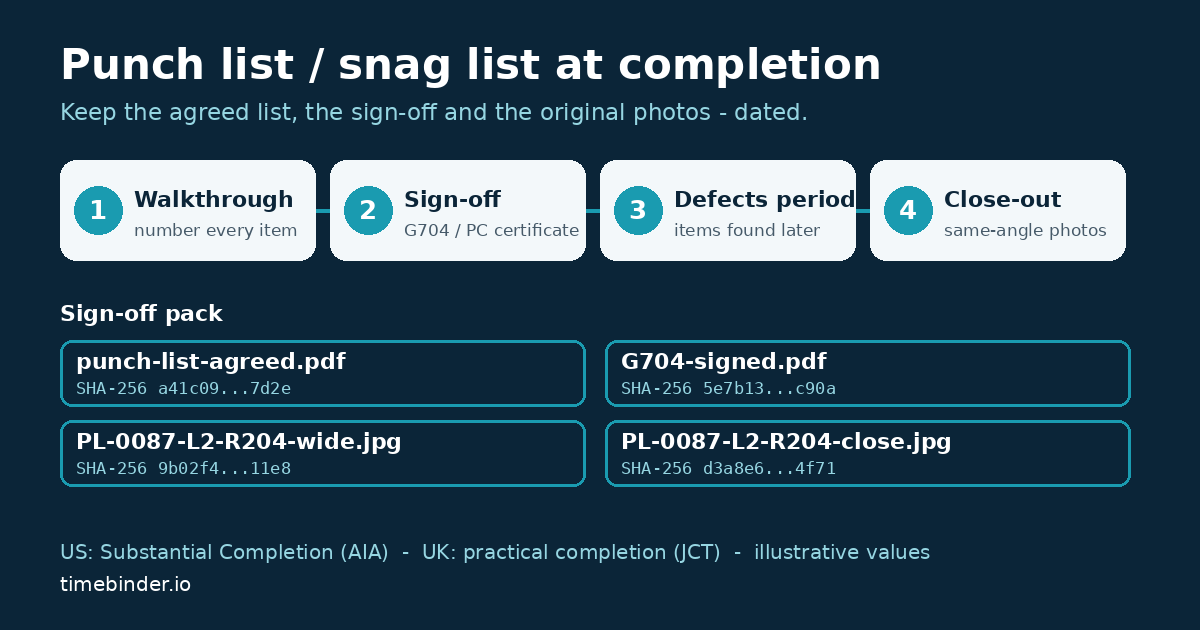
Short answer: on the day of the walkthrough and sign-off, keep the exact list that was agreed (as the PDF or export that was attached or sent), the signed certificate or acceptance record, and the original photo files for every item: a wide shot to locate it and a close shot of the fault. Name the photos with the item number, keep the camera originals rather than copies from a chat app, and record a fingerprint of the whole set the same day. Do it again when items are closed out. In a later argument about whether something was on the list, already damaged at handover or ever fixed, that dated set is what you will want.
Click here to start: your first TimeBind is free →
Free plan, no credit card needed. Your file stays on your device.
TimeBinder adds a layer of protection against AI and human fraud and disputes. A TimeBind is a dated, checkable record that an exact file existed no later than a recorded time and still matches. The fingerprint is made in your browser and the file stays on your device, so you can record a whole punch list pack without handing the photos to anyone.
By Inna Hall, Australian lawyer and co-founder of TimeBinder. Last checked 19 November 2026 against AIA, JCT/RICS, French and German sources listed at the end. General information, not legal or contract advice for a specific project; the US, European and UK rules below are separate systems.
Table of contents
- The short answer
- The three arguments a punch list ends up in
- What the contract calls it: US, Europe, UK
- United States: AIA Substantial Completion
- Europe: France and Germany
- United Kingdom: JCT practical completion
- A sign-off day routine
- Photos: what makes them useful later
- What a dated record does not do
- Frequently asked questions
- Sources checked
The short answer
The punch list (in the UK, the snag list) is the last big record of a building project before the owner moves in. It looks like a housekeeping document: a few hundred lines about paint touch-ups, door closers and missing trims. It is also the document most likely to be argued over months later, because three things depend on it: payment of the final amount or retention, when warranty or defects periods start, and who pays for damage found after the owner took over.
This guide covers the evidence side of that list: which files to keep, how to make the photos useful, and how to show later which version of the list and which photos existed on sign-off day. It does not tell you when your project is complete; that is for your contract and the person who certifies under it. For the drawings handed over at the same stage, see as-built drawings: timestamp the set you hand over at completion, and for the full project picture, an architect’s evidence routine from concept to as-built. Both sit in our architecture timestamping hub.
The three arguments a punch list ends up in
Seen from a lawyer’s desk, completion disputes rarely turn on the contract wording alone. They turn on what the parties can show about the building on a particular day. Almost every punch list argument is one of these:
- “That was never on the list.” The owner says a cracked tile or a scuffed wall was raised at the walkthrough; the contractor says it appeared after the owner’s fit-out team moved in. The question is what the building looked like at handover, and which version of the list was agreed.
- “That was fixed weeks ago.” The contractor says an item was closed out; the owner says it was never done, or done badly. The question is what the close-out photos show and when they existed.
- “That’s not the list we signed.” Punch lists live in spreadsheets and apps and get edited after the walkthrough: items merged, re-worded, marked closed, deleted. The question is which version was attached to the certificate or sent with it.
Each of these is a question about a file at a date. Software logs and email help, but they are held by one party or one provider. A set of exact files with a recorded fingerprint is a check either side can run later.
What the contract calls it: US, Europe, UK
The same moment has different legal names, and the consequences differ. Do not carry one system’s rules into another.
United States (AIA A201 and G704)
Handover event: Substantial Completion
The list: Contractor’s list of items to be completed or corrected, checked and amended by the architect, attached to the G704
Afterwards: Correction period, generally one year from Substantial Completion (A201 section 12.2.2)
France (Code civil art. 1792-6)
Handover event: Réception (acceptance), with or without reservations
The list: Réserves written in the procès-verbal de réception
Afterwards: Garantie de parfait achèvement: one year from réception, for reserved items and defects notified in writing later
Germany (BGB sections 640 and 650g)
Handover event: Abnahme (acceptance)
The list: Known defects must be reserved at Abnahme; if acceptance is refused for defects, a dated joint condition record can be required
Afterwards: Warranty claims for defects; periods depend on the contract type and terms
United Kingdom (JCT, e.g. Standard Building Contract)
Handover event: Practical completion, certified by the contract administrator
The list: Snag list (industry usage, not a JCT term) issued around practical completion
Afterwards: Rectification Period from practical completion (six months by default if none is stated), then a schedule of defects and a certificate of making good
United States: AIA Substantial Completion
On projects using AIA documents, the G704-2017 Certificate of Substantial Completion records the date of Substantial Completion of the work or a designated portion. AIA’s own instructions say the contractor prepares a list of items to be completed or corrected, the architect verifies and amends it, and the list is attached when the form is issued for acceptance by the contractor and the owner. The form also records the time allowed to finish those items, when the owner will occupy, and who is responsible for maintenance, heat, utilities and insurance.
Two points in the G704 wording matter for records. First, the date of Substantial Completion is also when the warranties required by the contract documents generally begin, unless the form says otherwise. Second, leaving an item off the list does not relieve the contractor of its obligation to complete all the work in line with the contract documents. So the list is not the last word on what is owed, but it is strong evidence of what everyone saw and agreed on that day. Under A201-2017, the general conditions behind the G704, the contractor’s correction obligation generally runs for one year from Substantial Completion (section 12.2.2).
The AIA’s guidance on using photography to evaluate on-site work is blunt about photos: photograph deviations from as many angles as needed and close enough to see the defect, include a scale where size matters, and be aware that a photo showing a defect you did not report can be used against you. That last point is a reason to keep the photos and the list together, not to keep fewer photos.
Many US projects use ConsensusDocs, owner-drafted or state public-works contracts instead, with their own terms. State law on retainage and liens also varies.
Europe: France and Germany
There is no single EU rule on construction acceptance; each country’s civil code and standard terms apply. Two large systems show why dated condition records matter.
- France. Under article 1792-6 of the Code civil, réception is the act by which the owner accepts the works with or without reservations (réserves), and it is made in the presence of both sides. The contractor’s one-year garantie de parfait achèvement runs from réception and covers defects reserved in the procès-verbal de réception or notified in writing afterwards. In practice the reserve list and its photos are the French punch list, and what is reserved on the day matters.
- Germany. Under section 640 BGB, the client cannot refuse Abnahme (acceptance) because of insignificant defects, and a client who accepts work knowing of a defect keeps certain rights only by reserving them at acceptance. For construction contracts, section 650g BGB goes further: if the client refuses acceptance citing defects, the contractor can ask for a joint record of the condition of the work, dated and signed by both. If the work has been handed over and an obvious defect is missing from that record, it is presumed to have arisen afterwards and to be the client’s responsibility, unless it could not have been caused by the client. Few rules show more clearly why the date and content of a condition record matter.
United Kingdom: JCT practical completion
Under the JCT Standard Building Contract the contract administrator certifies practical completion. Most JCT forms do not define practical completion, and “snagging list” is industry usage rather than a contract term. English courts have long accepted that practical completion can be certified while minor items remain outstanding (often cited: H W Nevill (Sunblest) Ltd v William Press & Son Ltd, 1981), which is exactly why a snag list exists.
After practical completion comes the Rectification Period. RICS guidance on defects and rectifications notes it runs for the period in the Contract Particulars, often 12 or 24 months, with a default of six months if none is stated, and that the contract administrator can issue a schedule of defects as an instruction up to 14 days after the period ends. A certificate of making good follows, and retention is commonly released in stages around these events. Contract forms and versions differ (Design and Build, Minor Works, and Scottish SBCC editions), so check yours.
Practical tip for UK projects: keep one register for snags at practical completion and defects found during the Rectification Period, with the stage recorded against each item, rather than starting a new list. Whether an item was a snag at handover or a defect that appeared later is often the point in dispute.
A sign-off day routine
This works for an architect or contract administrator, a contractor’s project manager, or an owner’s representative. It adds perhaps fifteen minutes to the day.
- Before the walkthrough, fix the list’s numbering. Every item gets a permanent number and a location a stranger could find (level, room, gridline). Never renumber later; close items, do not delete them.
- Photograph every item twice. A wide shot that shows where it is and a close shot that shows the fault, with a tape or scale where size matters. Name the files with the item number, for example
PL-0142-L3-R305-close.jpg. - Keep camera originals. Export originals from the phone or the punch list app. Photos sent through messaging apps are often recompressed and lose their metadata, so they are new files with different fingerprints.
- Save the agreed list as a file. Export the list to PDF or CSV exactly as it was attached to the G704, certificate or procès-verbal. A live app view is not a record; the export is.
- Make one sign-off pack. The signed certificate or acceptance record, the list export, the photo originals and any drawings referred to. Create a fingerprint list of the whole folder with the bulk SHA-256 hash manifest tool, which runs in your browser.
- Record it the same day. TimeBind the pack, or at least the manifest file and the signed certificate. The record shows those exact files existed no later than that day.
- Send it with a transmittal. Send the same files to the other parties with a transmittal that lists them, and keep the exact copies you sent. Our file handover log builder gives you a simple format.
- Repeat at close-out. When items are completed, take resolution photos from the same angle, update the register, and record the close-out batch the same way. Do it again at the end of the correction or Rectification Period.
Illustrative example (not a real client): an architect certifies practical completion of a small office fit-out with a 214-item snag list. Six weeks later the client reports long scratches on a timber floor in the meeting room and asks the contractor to replace it as a defect. The contractor says the floor was clean at handover and the scratches came from the client’s furniture move. Item 0087 on the snag list is a small chip near the door, and the wide photo for that item shows the rest of the floor without scratches. The architect’s sign-off pack was fingerprinted and recorded on the afternoon of practical completion, and the copies sent to both parties match it. Nobody has to argue about whether the photo set was assembled later; the discussion moves on to the furniture move.
Photos: what makes them useful later
- Original files, not screenshots or chat copies. Each re-save or re-share makes a new file. Our article on date created vs date modified vs date taken explains which dates survive copying, and how to verify when a photo was taken covers metadata and its limits.
- Metadata is helpful but editable. The camera’s capture date and GPS can be changed with free tools. Treat them as supporting detail, with the walkthrough date, the list and an outside record holding it together.
- Same angle before and after. A close-out photo taken from the same position as the snag photo is much easier to compare.
- Wide context matters. The wide shots often settle the “was it already damaged?” question about things that were not on the list at all.
- Drone and scan data too. If a drone survey or 3D scan was taken at handover, record it as well; see timestamping drone surveys and 3D site scans.
Punch list software keeps its own history of who changed what. Export that history at sign-off and at close-out. It is useful, but it is held by the provider and administered by one party, so an exported, fingerprinted copy is the part you control.
What a dated record does not do
A TimeBind does not show who took a photo, where it was taken, that it shows what someone says it shows, or that the work was complete or defective. It does not certify completion or replace the G704, the practical completion certificate, the procès-verbal or a joint condition record. It gives you a dated, checkable record that the exact files existed no later than the recorded time, and lets anyone check later whether a copy still matches, using a free check such as our SHA-256 file hash checker or the steps in how to check a file still matches its fingerprint.
If a dispute is likely, talk to a lawyer qualified where the project is, before deleting or editing anything in the punch list app. Keep the originals as they are.
Related reading: as-built vs record drawings, as-built drawings at completion, our architecture timestamping hub and the wider industry evidence routines.
Frequently asked questions
-
Is a punch list the same as a snag list?
Broadly, yes. Punch list is the usual US term and snag list (or snagging list) the usual UK term for the items still to be finished or put right when a building is handed over. Neither term is defined in the main AIA or JCT forms. The contract words that matter are different: Substantial Completion and the list of items to be completed or corrected under AIA documents, and practical completion, the Rectification Period and the schedule of defects under JCT contracts.
-
Who prepares the punch list under AIA documents?
Under AIA A201-2017 and the G704 Certificate of Substantial Completion, the contractor prepares a list of items to be completed or corrected, and the architect inspects, adds to or amends it. When the architect finds the work substantially complete, the list is attached to the G704. Many US projects use other contract forms, so check yours.
-
What is the difference between the snag list and defects found later?
Snags are items known at handover. Defects that appear afterwards are handled in the period that follows: the correction period under AIA A201 (generally one year from Substantial Completion), the Rectification Period under JCT (six months from practical completion if the Contract Particulars state nothing), and the one-year garantie de parfait achevement in France. Keep both on one register with the stage marked, because which list an item belongs to is often what a later disagreement is about.
-
Can a TimeBind show when a site photo was taken?
No. It records that the exact photo file existed no later than the recorded time and lets anyone check later that a copy still matches. The capture date comes from the camera metadata and your own notes, which can be edited. A TimeBind made on the day of the walkthrough narrows the window: the photo cannot have been created after that time.
-
Should I send the photos to the other side as well?
Usually that is good practice, and in France and Germany acceptance is a joint step. Sending the list and photo set with a transmittal gives the other side the same record and shows what was issued and when. Keep the exact files you sent, and record their fingerprints, so you can later show the copy you hold is the one that was sent.
-
Does recording the punch list change what the contract says?
No. A dated record of a list or photo does not certify completion, approve work or change anyone’s obligations. It only helps show which version of a file existed by a recorded time. The contract and the certificates issued under it still decide completion, payment and defects.
Sources checked
- AIA Contract Documents, Instructions: G704-2017, Certificate of Substantial Completion, read 19 November 2026; G704-2017 form wording on warranties and the list of items to be completed or corrected.
- AIA, Using photography to evaluate on-site work, read 19 November 2026.
- AIA A201-2017 General Conditions, sections 9.8 (Substantial Completion) and 12.2.2 (correction period). The full text is licensed by AIA and not freely published; check your project copy.
- RICS, Defects and rectifications (2nd edition), on JCT Rectification Period defaults and schedules of defects. The RICS site blocks automated access; text read from a consolidated copy on 19 November 2026.
- Légifrance, Code civil, article 1792-6. Légifrance blocks automated access; text checked against published copies of the article on 19 November 2026.
- Gesetze im Internet, BGB section 640 (Abnahme) and BGB section 650g (Zustandsfeststellung), read 19 November 2026.
Record your sign-off pack
- Open the app and sign in with email or Google.
- Add the exact files: the list export, the certificate and the photo originals or their manifest. They stay on your device.
- Seal them and download your Proof of Time certificates.
Your first Pooled TimeBind is free, with no card required. After that, Pooled TimeBinds start from US$5, and an ASAP TimeBind is US$15. Open TimeBinder, or see plans and pricing.