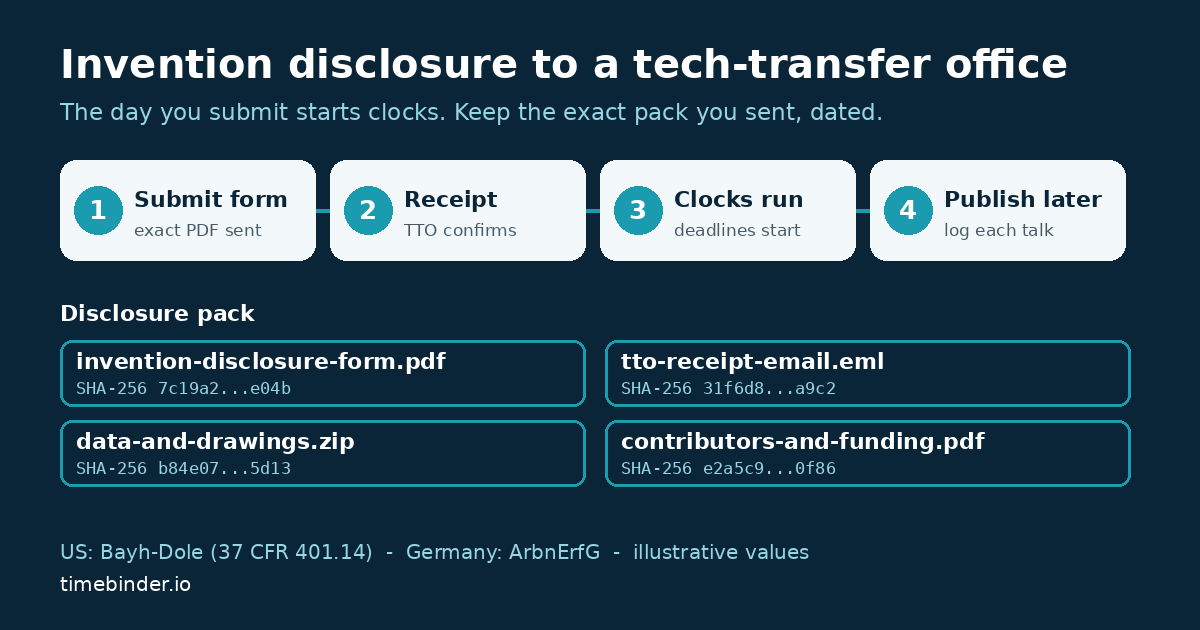
Short answer: when you submit an invention disclosure to your university’s technology-transfer office (TTO), keep the form exactly as submitted, the office’s dated acknowledgement, every attachment in the version you sent, your contributor and funding notes, copies of every IP agreement you have signed, and a log of every talk, poster, paper or email that described the invention. Record a fingerprint of the whole pack on the day. The submission date can start legal deadlines, in the US under Bayh-Dole and in Germany under the Employee Inventions Act, and later questions about what you disclosed, and when, turn on those files.
TimeBinder adds a layer of protection against AI and human fraud and disputes. A TimeBind is a dated, checkable record that an exact file existed no later than a recorded time and still matches. The fingerprint is made in your browser and the file stays on your device, so you can record an unpublished disclosure pack without sending its contents anywhere else.
By Inna Hall, Australian lawyer and co-founder of TimeBinder. Last checked 20 November 2026 against the US, German, European and UK sources listed at the end. General information, not legal or patent advice. The US, German, European patent and UK rules below are separate systems; speak to your tech-transfer office or a patent attorney about your invention.
Table of contents
- The short answer
- Why the day you submit matters
- United States: Bayh-Dole and the one-year grace period
- The Stanford v. Roche lesson: keep every agreement you signed
- Europe: absolute novelty and employee-invention law
- United Kingdom: section 39 and university policy
- The disclosure pack: what to keep
- A submission-day routine
- Illustrative example
- What a dated record does not do
- Frequently asked questions
- Sources checked
The short answer
An invention disclosure form looks like paperwork: a title, a description, some names and a funding box. In practice it is the first formal record of your invention inside the university, and often the document people go back to years later. It is read when the office decides whether to file, when a funding agency asks when it was told, when co-inventors disagree about who contributed, and when someone asks whether a paper or a conference talk came before the patent application.
The form itself is held in the university’s system. You will usually want your own copy of exactly what you sent, the attachments as they were, and a record you control of when that pack existed. That is the gap this guide covers. It sits alongside the wider invention records routine for the US and EPO and the invention records hub.
Why the day you submit matters
Different systems attach different consequences to a disclosure. The point is not that you should memorise them, but that the date and content of what you submitted can matter in each:
United States (federally funded research)
What starts it: Your written disclosure to the people responsible for patent matters
What follows: University discloses to the funding agency within two months (37 CFR 401.14(c)(1)); election of title within two years; filing before the one-year grace period under 35 U.S.C. 102(b) runs out
Germany (ArbnErfG)
What starts it: Your separate report in text form (section 5)
What follows: Employer confirms the date of receipt; the invention is treated as claimed after four months unless released in text form (section 6(2)); university inventors give notice, usually two months, before publishing (section 42)
European patent (EPC)
What starts it: Any public disclosure before filing, including your own
What follows: Absolute novelty (Article 54); only the narrow Article 55 exceptions, within six months, for evident abuse or a recognised exhibition
United Kingdom (Patents Act 1977)
What starts it: Your report under the university’s IP policy
What follows: Section 39 decides whether an employee’s invention belongs to the employer; timing rules come mainly from the policy and your contract
Your university’s own policy and your funding or sponsor agreements sit on top of all of these. Read the version that applied on the day you submitted, and keep a copy of it.
United States: Bayh-Dole and the one-year grace period
Most US university research with federal money is covered by the Bayh-Dole Act, 35 U.S.C. sections 200 to 212. The standard patent rights clause for universities and other non-profits is in 37 CFR 401.14. Three parts of it make the disclosure date matter:
- Two months to tell the agency. The university must disclose each subject invention to the federal agency within two months after the inventor discloses it in writing to contractor personnel responsible for patent matters (37 CFR 401.14(c)(1)). The statute, 35 U.S.C. 202(c)(1), allows the government to receive title to an invention not disclosed within the required time.
- Two years to elect title, sometimes less. The university then has two years to elect in writing whether to keep title. If a publication, public use or sale has started the one-year US statutory period, the agency may shorten that to no more than 60 days before the period ends (401.14(c)(2)).
- Inventors must report in writing. The university must require its technical employees, by written agreement, to disclose subject inventions promptly in writing, in a format it suggests, and to assign them to the university (401.14(f)(2)). This is why your employment or IP agreement asks for a disclosure form.
The clause also asks the university to tell the agency whether a manuscript describing the invention has been submitted or accepted for publication. Your disclosure log is what lets you answer that accurately.
The US is a first-inventor-to-file system. Under 35 U.S.C. 102(b)(1), the inventor’s own disclosure made one year or less before the effective filing date is not prior art against that inventor. That grace period is a US rule. It does not carry over to Europe (see below), so a paper that is safe for a US filing can still be a problem for a European one.
The Stanford v. Roche lesson: keep every agreement you signed
In Board of Trustees of Leland Stanford Junior University v. Roche Molecular Systems, Inc., 563 U.S. 776 (2011), the US Supreme Court held that the Bayh-Dole Act does not automatically vest title to federally funded inventions in the university. The inventor’s rights come first, and the university gets them by assignment.
The facts are why this matters for record-keeping. A Stanford researcher had signed a university agreement saying he “agree[d] to assign” future inventions. He later signed a visitor’s confidentiality agreement at the company Cetus saying he “will assign and do hereby assign” inventions made as a result of his work there. The Federal Circuit had held that the later, present-tense wording gave the company his rights, and the Supreme Court’s ruling left Stanford without the title it claimed under Bayh-Dole. Many universities changed their wording afterwards.
The practical lesson for a researcher: keep a dated copy of every IP-related document you sign, including visitor, consulting, collaboration and material transfer agreements, and list them on the disclosure form when asked. Months later, which document existed first, and in what wording, can be the whole question. Our guide to a prior inventions list before a new job covers the same issue when you move.
Europe: absolute novelty and employee-invention law
European patents. Under Article 54 EPC, an invention is new only if it is not part of the state of the art, which includes everything made available to the public before the filing date, in any way. Article 55 EPC excuses a disclosure only if it occurred no earlier than six months before filing and was due to an evident abuse in relation to the applicant, or to display at an official or officially recognised international exhibition. There is no general grace period for your own paper, poster or talk. For a European filing, the order of the disclosure form, the filing and the first public talk really matters, and the TTO needs to know about planned publications early. Our piece on patenting an invention shown publicly years ago goes further.
Germany. The Employee Inventions Act (Arbeitnehmererfindergesetz, ArbnErfG) applies to university staff, with special rules:
- Section 5: an employee who makes a service invention must report it to the employer without delay, separately, in text form, and mark it as an invention report. The employer must confirm the date of receipt in text form without delay. The report should describe the technical problem, its solution and how the invention came about, attach records needed to understand it, and name collaborators and their contribution.
- Section 6(2): the employer is treated as having claimed the invention if it does not release it in text form within four months after receiving a proper report.
- Section 42: an inventor employed at a university may disclose the service invention in teaching and research if they have notified the employer in good time, usually two months before. If the employer exploits it, the inventor’s remuneration is 30 percent of the income.
So in Germany both the content of the report and the date of receipt have legal effects, and the confirmation of receipt is a record you should keep with the exact report it confirms.
Other European countries have their own rules (for example France, in article L611-7 of the Code de la propriété intellectuelle), and they are not harmonised across the EU. Check the law of the country where you are employed and your institution’s policy.
United Kingdom: section 39 and university policy
Section 39 of the Patents Act 1977 decides when an employee’s invention belongs to the employer, mainly where it was made in the course of normal or specifically assigned duties in circumstances where an invention might reasonably be expected. Unlike Germany, there is no statutory report-and-claim timetable. The timing and form of disclosure come from the university’s IP policy and your contract. Students are often not employees, so their position usually depends on the policy and any agreement they signed. The UK is a party to the EPC, so the same absolute novelty point applies to a UK or European filing.
The disclosure pack: what to keep
Keep these together in one folder for each disclosure, named with the date and the TTO case number once you have it:
- The form exactly as submitted. Export the final PDF or a copy from the portal, not the editable draft. If the portal does not let you download it, save the confirmation page and the copy the system emails you.
- The office’s acknowledgement. The email or portal message with the date of receipt and the case or docket number. Save the original message file (.eml or .msg), not just a screenshot.
- Every attachment in the version you sent. Data, drawings, slides, code, draft manuscripts and the thesis chapter if one was attached. Change one figure afterwards and the file is no longer the one you disclosed.
- Contributors and contribution notes. Who worked on what, as you understood it on the day, plus visiting researchers, students and industry collaborators. The form usually asks for percentages; keep your own note of why.
- Funding and materials. Grant and contract numbers, sponsored research agreements, material transfer agreements and any data use terms. Under Bayh-Dole the funding agreement decides which clause applies.
- Every IP agreement you signed. University IP policy acknowledgement, assignment, visitor or consulting agreements, and any start-up or company agreement. See the Stanford v. Roche lesson below.
- A disclosure log. One line for each time the invention was shown or described outside the team: talks, posters, preprints, abstracts, theses, grant reports, emails to companies. Date, audience and the exact file shown.
If you used an AI tool while developing or writing up the invention, keep the terms and the exact prompts or outputs that matter; see the AI-assisted invention record checklist. If you are about to show the invention to a company, the NDA and timestamp before disclosure guide covers that step.
A submission-day routine
- Freeze the attachments. Put the final versions in the folder. Do not edit them after this point; make new versions with new names.
- Submit, then download. Download the submitted form and save the acknowledgement message as an original file.
- Make a manifest. List every file with its SHA-256 fingerprint, for example with the free bulk SHA-256 hash manifest tool, which runs in your browser.
- Record the pack. Create a TimeBind for the manifest or the key files the same day.
- Update the log. Add every later talk, preprint, poster or company meeting to the disclosure log, with the exact file shown, and tell the TTO before it happens.
- Repeat for updates. When you send the office new data or a revised description, repeat steps 2 to 4 for that update.
For data-heavy projects, see also timestamping research data. The same habit works for the files you hand over to a collaborator; a handover receipt records what was sent.
Illustrative example
This is an illustrative example, not a real case. A postdoc submits a disclosure on a new sensor coating on 3 March, attaching a slide deck and a data spreadsheet. In June she presents at a conference. Two years later, a co-author who has moved to a company says the conference slides showed a version of the coating that was not in the disclosure, and that he had developed it. The university’s portal shows a disclosure was received on 3 March, but the attachments were later replaced when the postdoc uploaded corrected data. Her own folder still holds the original deck and spreadsheet, the acknowledgement email, a manifest with their fingerprints and a TimeBind made on 3 March. Anyone can check that those files still match the March record. That does not decide who invented the coating, but it settles what the March disclosure actually contained.
What a dated record does not do
A TimeBind does not file or replace a patent application, set a priority date, extend a grace period, or excuse a late report to a funding agency or employer. It does not show who invented something, that an invention is new, or who holds title. It gives you a dated, checkable record that the exact files existed no later than the recorded time, and lets anyone check later whether a copy still matches, using a free check such as our SHA-256 file hash checker or the steps in how to check a file still matches its fingerprint. For the difference from filing, see provisional patent vs a timestamp and how to prove an invention date.
If there is already a disagreement about inventorship or title, talk to a lawyer or patent attorney qualified where you work before deleting or editing anything. Keep the originals as they are.
Related reading: our inventor timestamping hub and the invention records hub.
Frequently asked questions
-
Does submitting an invention disclosure form protect my invention?
No. An invention disclosure form is an internal report to your university. It does not file a patent application, set a priority date or stop anyone else filing. It does start the university’s own review, and for federally funded US research it starts the Bayh-Dole reporting clock. Talk to the tech-transfer office or a patent attorney before you publish or present.
-
How long does a US university have to report my invention to the funding agency?
Under the standard Bayh-Dole patent rights clause (37 CFR 401.14(c)(1)), the university must disclose each subject invention to the federal agency within two months after the inventor discloses it in writing to the people responsible for patent matters. It then has up to two years to elect whether to keep title, which can be shortened if a publication or sale has started the one-year US grace period. Your own grant terms may add detail.
-
Is the European rule on publishing before filing the same as the US one?
No. In the US, 35 U.S.C. 102(b)(1) gives a one-year grace period for the inventor’s own disclosures. Under the European Patent Convention, novelty is absolute (Article 54), and Article 55 only excuses disclosures within six months that came from an evident abuse or display at an officially recognised international exhibition. Publishing your own paper first can destroy novelty for a European patent.
-
I work at a German university. Can I still publish?
Section 42 of the German Employee Inventions Act (ArbnErfG) lets university inventors disclose a service invention in their teaching and research if they notify the employer in good time, usually two months before. Keep a dated copy of that notice and of the report itself. Your university’s rules and any funding contract also apply.
-
Can a TimeBind replace the tech-transfer office’s receipt?
No. The office’s acknowledgement is the record of when it received your report, and in Germany the employer must confirm the date of receipt in text form (ArbnErfG section 5(1)). A TimeBind is a separate, dated, checkable record that the exact files in your pack existed no later than a recorded time and still match, which helps if versions are later disputed.
-
Does a dated record show who invented it?
No. Inventorship is a legal question about who contributed to the conception of the claimed invention. A TimeBind does not show who wrote a file, who had an idea or who is entitled to anything. Keep contribution notes and lab records, and ask a patent attorney about inventorship.
Sources checked
- eCFR, 37 CFR 401.14, standard patent rights clause, paragraphs (c)(1) to (c)(3) and (f)(2), read 20 November 2026.
- Cornell LII, 35 U.S.C. 202, subsection (c), read 20 November 2026.
- Cornell LII, Stanford v. Roche, 563 U.S. 776 (2011), read 20 November 2026.
- Gesetze im Internet, ArbnErfG section 5, section 6 and section 42, read 20 November 2026.
- European Patent Office, EPC Article 54 and Article 55, read 20 November 2026.
- legislation.gov.uk, Patents Act 1977, section 39, read 20 November 2026.
Record your disclosure pack
- Open the app and sign in with email or Google.
- Add the exact files: the submitted form, the acknowledgement and the attachments, or their manifest. They stay on your device.
- Seal them and download your Proof of Time certificates.
Your first Pooled TimeBind is free, with no card required. After that, Pooled TimeBinds start from US$5, and an ASAP TimeBind is US$15. Open TimeBinder, or see plans and pricing.