When anyone can make a convincing fake video in minutes, the hardest problem in a dispute is often no longer spotting a fake. It is proving that a real file is real. This month, courts in the United States and Australia both moved on how AI-era evidence should be handled. Here is what changed, what it means for businesses and individuals who rely on digital files, and one practical step you can take before a dispute starts.
Table of Contents
What happened this month
On 15 October 2026, the US federal judiciary’s Advisory Committee on Evidence Rules met in Boston to hear expert panels on deepfakes and AI-generated evidence. Its agenda book describes a draft Rule 901(c) that the committee “has prepared, but not finally approved”. It would work in two steps:
- A party claiming that evidence was fabricated by generative AI must first produce evidence that could support a finding of fabrication. A bare allegation isn’t enough.
- If they do, the party relying on the evidence must show it is “more likely than not authentic”.
The committee hasn’t adopted the rule. As On The Wire reported on 19 October, any federal deepfake rule is likely still years away. The direction is still clear: when authenticity is challenged on credible grounds, the burden falls on whoever wants to rely on the file.
The “it’s a deepfake” defence
Courts are already seeing the other side of the problem. Some people now claim that genuine evidence is fake.
On 9 October 2026, the Iowa Supreme Court decided State v. Amyda. The defendant argued that a video used against him might be a deepfake. The court held that his “mere speculation that the video was a deepfake was not enough to bar its admission”. The video was admitted on the strength of circumstantial detail that a witness could personally recognise.
That outcome turned on the facts of a criminal case. For a business, the lesson is simpler. If a counterparty says your photo, recording, contract or report has been altered, you want more than your own word to answer them. You want something independent that shows the file existed in that exact form before the argument began.
Why detection alone won’t settle it
The expert panels themselves warned that detection is a moving target. According to the IBTimes UK report summarised by On The Wire, OpenAI policy counsel Shira Anderson told the committee she did not think “there will be a scientific way going forward to detect” AI images, and that watermarking would not be “bulletproof”.
The same agenda book records a Federal Judicial Center survey: of 931 US judges who responded, only 15 had encountered a deepfake challenge. Those challenges are rare today, but the tools behind them keep getting cheaper and better.
Detection asks “does this file look fake?” Provenance asks a different and often more useful question: “can we show this exact file existed, unchanged, at a particular time?” Metadata can help, but the committee’s materials note that it can be edited, stripped or spoofed. Social platforms also routinely recompress uploads and strip it.
What Australian courts are signalling
Australia isn’t drafting a deepfake rule like 901(c), but its courts are tightening expectations around AI. From 21 October 2026, the Supreme Court of Tasmania’s generative AI guidelines apply to lawyers, litigants, witnesses and anyone else preparing documents for the court. Users must verify AI-assisted content before filing and be ready to explain which tools they used. The court can give such documents less weight, disregard them, order costs, or refer lawyers to the Legal Profession Board.
These guidelines are about using AI to prepare documents, not about deepfakes. They point the same way, though. Courts increasingly expect parties to show where their material came from and how it was checked.
What a blockchain timestamp proves, and what it doesn’t
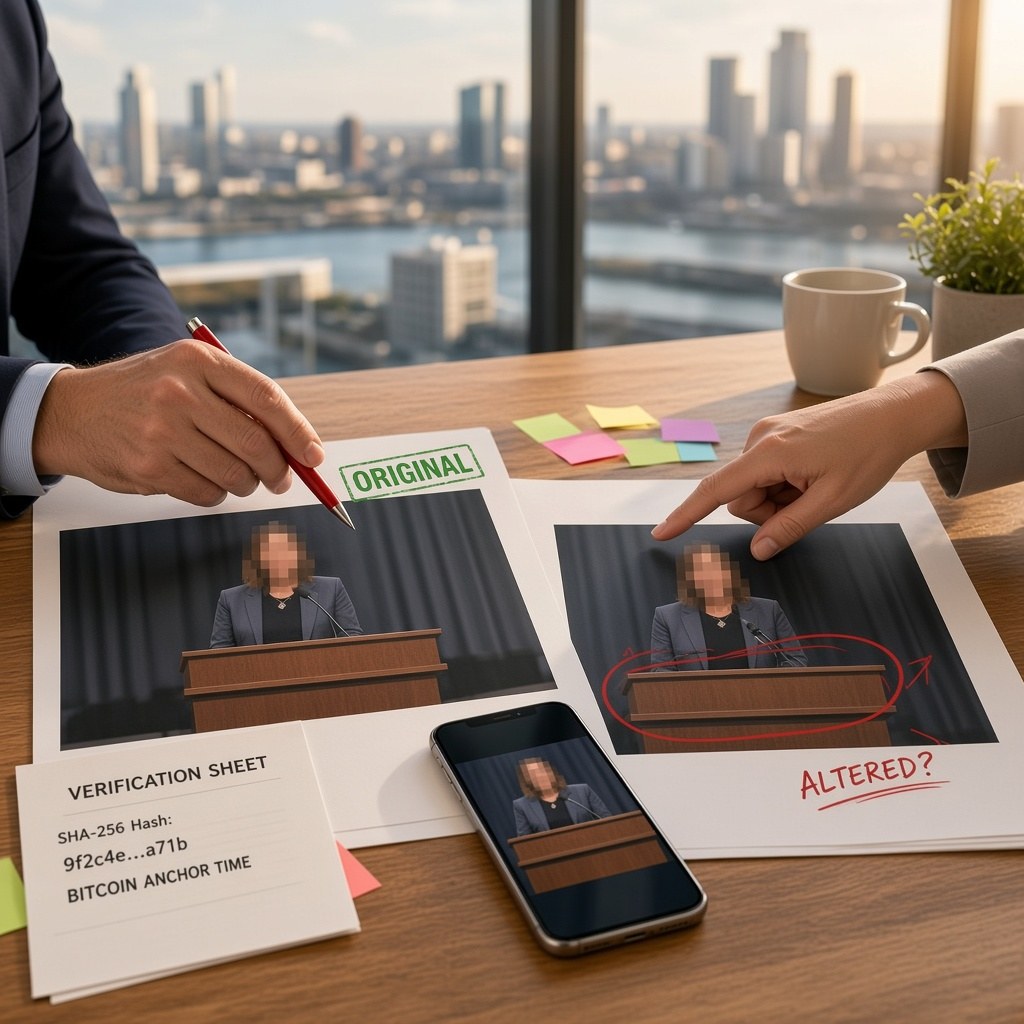
A cryptographic hash is a digital fingerprint of a file. With SHA-256, changing even one pixel or one comma produces a completely different fingerprint. A blockchain timestamp records that fingerprint on a public blockchain, which shows the file existed in that exact form no later than the time it was recorded.
That is what TimeBinder does. You choose your files in the TimeBinder app and each file is hashed locally in your browser. The files are never uploaded. Only the hash is anchored to the Bitcoin blockchain, and you receive a Proof of Time Certificate. Later, anyone you share it with can re-hash the file and check that it matches. An ASAP TimeBind gets its own Bitcoin transaction, so it can be checked on a public block explorer without relying on TimeBinder. A Pooled TimeBind is batched with other users’ hashes and verified through TimeBinder. (How verification works · ASAP vs Pooled)
It is just as important to be clear about the limits. A timestamp:
- does show that a specific file existed, byte for byte, by a verifiable time;
- does make any later change detectable, because an altered file won’t match the recorded hash;
- does not prove who created the file or that its contents are true;
- does not prove a file isn’t AI-generated. A fake can be timestamped too;
- does not decide admissibility. That is always a matter for the court.
So where does it help with deepfake evidence? Mostly in the “liar’s dividend” scenario, when someone claims your genuine file was doctored after a dispute arose. If the original recording was TimeBound on the day it was made, months before anyone had a motive to fake it, that claim becomes much harder to sustain. A timestamp works best as one strand alongside the device the file came from, witness evidence and your normal record-keeping.
Practical steps before a dispute
- Timestamp originals, not copies. Messaging apps and social platforms re-encode files, which changes the hash. TimeBind the file straight from the camera, recorder or document system.
- Do it at creation. A timestamp from the day a file was made carries far more weight than one made after a dispute starts.
- Keep the original file safe. Verification needs the exact file. TimeBinder never stores your files, so keep them backed up.
- Choose ASAP for files likely to be contested. Independent public verification avoids any argument about relying on a provider’s systems.
- Record context. Use the optional Reference and Details fields to note what the file is and where it came from.
- Get legal advice early. If authenticity is challenged, talk to a lawyer about how your timeline evidence fits your case.
AI can rewrite files. It can’t rewrite time. Create a verifiable record of your important photos, recordings and documents today, before anyone has a reason to question them.
This article is general information, not legal advice. Sources were checked on 23 October 2026.
Frequently Asked Questions
-
Is a deepfake rule in force in US federal courts?
No. Draft Rule 901(c) has been prepared but not approved or published for comment. On The Wire’s reading of the committee’s materials is that any rule is likely years away.
-
Can a blockchain timestamp prove a video isn’t a deepfake?
No. It proves the file existed in that exact form by a certain time and hasn’t changed since. That helps answer claims that a genuine file was altered later, but it doesn’t vouch for how the content was made.
-
Do I have to upload my files to TimeBinder?
No. Files are hashed locally in your browser, and only the SHA-256 hash is anchored to Bitcoin.
-
Does this matter in Australia?
Australian courts are setting clearer expectations about AI. Tasmania’s new guidelines are one example. Showing where a file came from and that it hasn’t changed is useful anywhere digital evidence is challenged. A lawyer can advise on your specific situation.
-
What does it cost to start?
The Free plan includes one Pooled TimeBind a month. See pricing.