
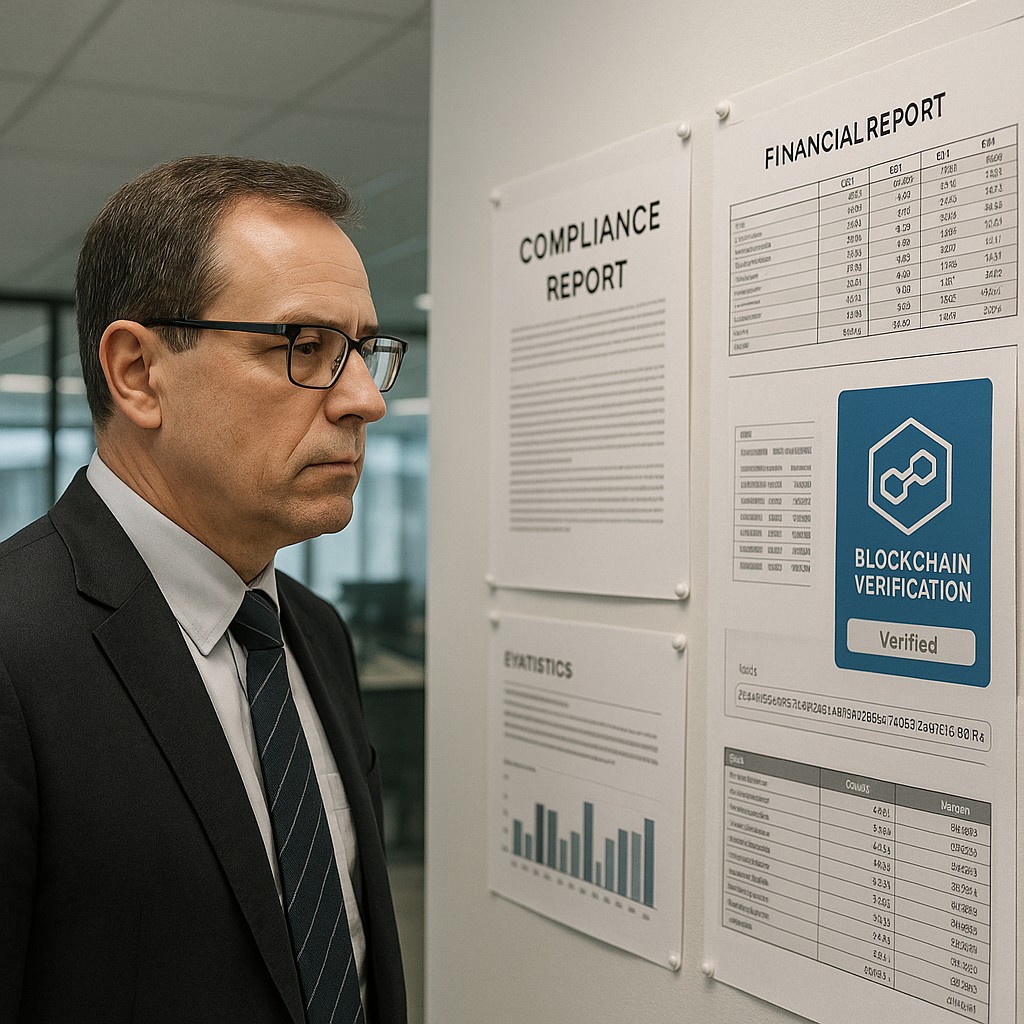
A disputed trade confirmation triggered a regulatory escalation. A mid-sized asset management firm faced allegations that it altered a transaction report after market close, exposing it to fines, license review, and severe reputational harm. The conflict centered on document timing and authenticity, placing financial document verification at the heart of the investigation. The outcome ultimately hinged on independently verifiable evidence anchored by a blockchain timestamp. This fictional case study is illustrative but reflects realistic compliance risks and professional consequences in regulated financial markets.
Table of Contents
Background of the Dispute
Orion Capital Advisors executed a series of high-value bond trades during a volatile market session. One institutional client later alleged that the final trade confirmation, delivered after market close, contained pricing terms that differed from what had been agreed earlier that afternoon. The client claimed the firm amended the document retrospectively to shield itself from a pricing error.
The allegation triggered an internal compliance review and a formal inquiry from the national financial regulator. At issue was whether the trade confirmation document had been modified after its stated issuance time. The firm’s head of compliance had recently implemented a policy requiring cryptographic timestamping of all outbound trade confirmations as part of enhanced financial document verification controls.
Why Document Timing Matters in Finance
In regulated markets, timing determines enforceability, disclosure compliance, and exposure allocation. A document issued before market close may carry different legal implications than one generated afterward. Even small discrepancies can influence valuation, reporting obligations, and fiduciary accountability.
Document timing establishes sequence, and sequence establishes responsibility. In high-value transactions, chronology can determine liability.
Regulators assess not only what a document contains but also when it came into existence. Audit trails, metadata, and transmission logs are often scrutinized for evidence of post-event alterations. In simple terms, if a firm cannot prove when a file existed in its final form, it cannot reliably defend itself against claims of retroactive editing.
Independent financial financial document verification solutions are increasingly used to mitigate these risks by creating tamper-evident records of transaction documents at the moment they are finalized.
The Role of Blockchain Timestamping
A blockchain timestamp is a cryptographic record showing that specific data existed at or before a particular time, anchored to a public blockchain ledger.
Proof of existence confirms that a digital file was in a specific state at a certain moment. Proof of time establishes the chronological reference associated with that state.
A timestamp is a recorded assertion of date and time linked to data. Digital file integrity refers to the assurance that a file has not been altered since a reference point.
Proof of existence, proof of time, digital file integrity, and blockchain anchoring together create an independently verifiable record that a specific cryptographic hash corresponded to a given file at a defined historical moment.
What a blockchain timestamp proves is narrowly defined. It proves that a unique cryptographic hash representing a file was recorded on the blockchain at or before a specific block time. Because any modification to the file would generate a different hash, the record indirectly proves that the file has not changed since that recorded moment.
For Orion Capital Advisors, each finalized trade confirmation was hashed locally in the user’s browser using SHA-256. Only the cryptographic hash was anchored to the Bitcoin blockchain. Files were never uploaded and remained on the user’s device, preserving confidentiality of client data.
Technical Implementation and Verification
The compliance department had adopted a dual-option timestamping policy. High-value trades above a defined monetary threshold were processed using the “ASAP Priority” option, enabling independent verification through public blockchain explorers. Lower-risk documents were processed through the “Pooled Priority” option, where verification required access to the TimeBinder.io website or TimeBinder Application.
The disputed confirmation fell within the high-value category and had been processed using ASAP Priority. This meant that the anchored hash could be verified independently via blockchain.com/explorer without reliance on proprietary systems.
During the regulatory review, Orion’s compliance officer generated the original trade confirmation file from secure archives. Using established blockchain file verification procedures, the team recalculated the SHA-256 hash locally. The resulting hash matched the one embedded in the Bitcoin transaction recorded hours before the market closed.
The regulator independently repeated the hashing process. The hash values were identical. The block timestamp predated the alleged amendment window by nearly three hours.
Regulatory Review and Resolution
The client’s claim relied primarily on email metadata suggesting a later transmission time. However, transmission time does not necessarily reflect document creation time. The cryptographic evidence demonstrated that the file in question already existed in its disputed form before the alleged alteration period.
The regulator concluded that while the email was sent later due to internal approval workflows, the document itself had not been modified after its initial finalization. The blockchain timestamp served as neutral, third-party corroboration of the document’s state prior to transmission.
Importantly, the regulator emphasized that the blockchain record did not validate the commercial fairness of the trade. It only confirmed digital file integrity and chronology. Nonetheless, this narrow proof resolved the core allegation of retrospective editing.
The inquiry closed without enforcement action. Orion Capital Advisors documented the event internally as a compliance stress test and strengthened its timestamping requirements for all trade-related documents.
Lessons Learned
Timestamped records reduce evidentiary uncertainty in high-risk disputes.
This fictional case illustrates that document disputes in finance rarely revolve around dramatic fraud. More often, they hinge on chronology conflicts, procedural ambiguity, or inconsistent recordkeeping.
A blockchain timestamp does not replace contractual clarity or ethical conduct. It does, however, create objective evidence of proof of existence and proof of time that can withstand external scrutiny.
For regulated institutions, proactive financial document verification can transform a potentially career-ending allegation into a manageable compliance review. By anchoring only cryptographic hashes to the Bitcoin blockchain and keeping files on local devices, firms can balance confidentiality with transparency.
In environments where professional licenses, fiduciary duties, and regulatory standing are at stake, independently verifiable timestamps provide a measurable safeguard against escalation driven by uncertainty.
Frequently Asked Questions
- What does a blockchain timestamp actually verify?
A blockchain timestamp verifies that a specific file hash existed at or before a recorded block time on the blockchain.
- How is proof of existence defined?
Proof of existence is cryptographic evidence that a specific digital file existed at a particular moment in time.
- Can regulators independently confirm a blockchain timestamp?
Yes. An ASAP Priority blockchain timestamp can be verified independently using public blockchain explorers without relying on proprietary platforms.
- Are confidential financial documents uploaded during timestamping?
No. Files are hashed locally using SHA-256, and only the cryptographic hash is anchored to the blockchain, preserving confidentiality.
- Why is financial document verification important in disputes?
Financial document verification reduces ambiguity. A blockchain timestamp provides objective proof of time and digital file integrity in regulated investigations.







